## 双拼____小鹤双拼
[TOC=3,5]
<br>
#### 一、双拼方案
- 使用两个字母分别表示声母韵母,对汉字进行编码的方案
第一个字母表示**声母**,第二字母表示**韵母**
声母基本和键盘字母一致,双声母及韵母键位见下面“双拼键位图”
- 无声母的韵母音节用**零声母**代替声母
<br>
#### 二、零声母
- 指全拼中无声母的韵母音节,在双拼中需指定一个字母用来充当其声母,即零声母
1. 本方案以韵母首字母为零声母,即把韵母的首字母当作声母
单字母韵母,零声母 + 韵母所在键,如: 啊=aa 哦=oo 额=ee
双字母韵母,零声母 + 韵母末字母,如: 爱=ai 恩=en 欧=ou
三字母韵母,零声母 + 韵母所在键,如: 昂=ah
2. 简单说:<span style="color: #4183C4;">双字母音节保持全拼方式,一三字母音节为首字母加韵母所在键</span>
<br>
#### 三、双拼键位图
<div style="padding-left: 28px; margin-top: 15px;">
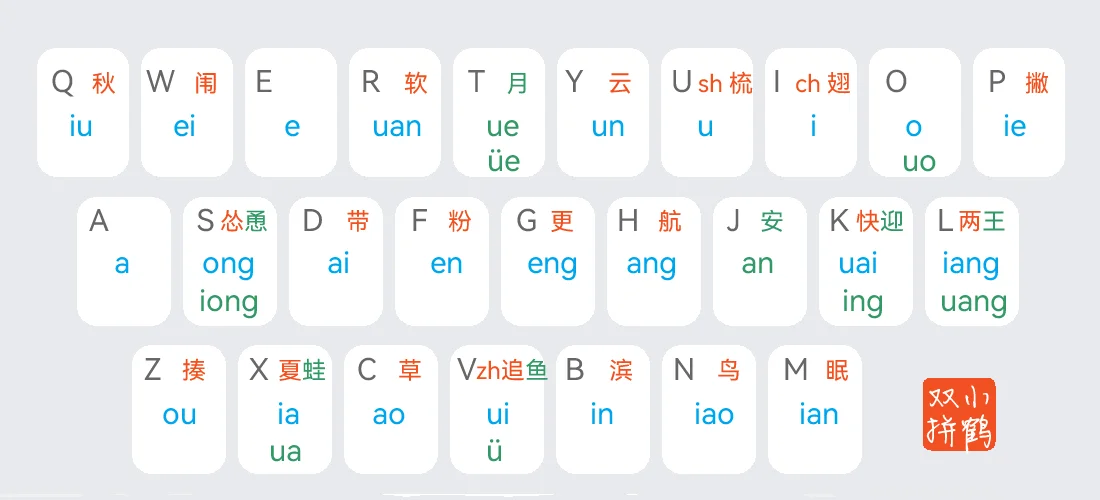
* 学习过程:一小时记忆键位,一周习惯双拼节奏,一月恢复全拼时速度
* <p align="left" style="color: #D9534F;">请在各拼音输入法的设置中选择本方案使用<p/>
</div>
<br>
#### 四、记忆口诀
<div style="padding-left: 28px; margin-top: 15px;">
<table style="table-layout: fixed; width: 100%;">
<colgroup>
<col style="width: 14%;">
<col style="width: 14%;">
<col style="width: 14%;">
<col style="width: 14%;">
<col style="width: 14%;">
<col style="width: 14%;">
<col style="width: 14%;">
</colgroup>
<tr>
<th>Qiu</th>
<th>Wei</th>
<th>Ruan</th>
<th>T_ue_ve</th>
<th>Yun</th>
<th>U_shu</th>
<th>I_chi</th>
</tr>
<tr>
<td>秋</td>
<td>闱</td>
<td>软</td>
<td>月</td>
<td>云</td>
<td>梳</td>
<td>翅</td>
</tr>
</table>
<table style="table-layout: fixed; width: 100%;">
<colgroup>
<col style="width: 14%;">
<col style="width: 14%;">
<col style="width: 14%;">
<col style="width: 14%;">
<col style="width: 14%;">
<col style="width: 14%;">
<col style="width: 14%;">
</colgroup>
<tr>
<th>Song</th>
<th>_iong</th>
<th>Dai</th>
<th>Fen</th>
<th>Geng</th>
<th>Hang</th>
<th>J_an</th>
</tr>
<tr>
<td>怂</td>
<td>恿</td>
<td>带</td>
<td>粉</td>
<td>更</td>
<td>航</td>
<td>安</td>
</tr>
</table>
<table style="table-layout: fixed; width: 100%;">
<colgroup>
<col style="width: 14%;">
<col style="width: 14%;">
<col style="width: 14%;">
<col style="width: 14%;">
<col style="width: 14%;">
<col style="width: 14%;">
<col style="width: 14%;">
</colgroup>
<tr>
<th>Kuai</th>
<th>_ing</th>
<th>Liang</th>
<th>_uang</th>
<th>Zou</th>
<th>Xia</th>
<th>_ua</th>
</tr>
<tr>
<td>快</td>
<td>迎</td>
<td>两</td>
<td>王</td>
<td>揍</td>
<td>夏</td>
<td>蛙</td>
</tr>
</table>
<table style="table-layout: fixed; width: 100%;">
<colgroup>
<col style="width: 14%;">
<col style="width: 14%;">
<col style="width: 14%;">
<col style="width: 14%;">
<col style="width: 14%;">
<col style="width: 14%;">
<col style="width: 14%;">
</colgroup>
<tr>
<th>Pie</th>
<th>Cao</th>
<th>V_zhui</th>
<th>_v</th>
<th>Bin</th>
<th>Niao</th>
<th>Mian</th>
</tr>
<tr>
<td>撇</td>
<td>草</td>
<td>追</td>
<td>鱼</td>
<td>滨</td>
<td>鸟</td>
<td>眠</td>
</tr>
</table>
</div>
<br>
<br>
#### 五、手指使用率分布
1. 小鹤双拼方案的设计目标:
- 左右手分布均衡
- 强弱指分配合理
- 减少同手跨排组合,降低使用频率
- 减少同手无名指小指组合,降低使用频率
2. 下面看看双拼测评系统测得的一些手指分布数据(积累中):
- 先一部《国士无双》
<div style="padding-left: 28px; margin-top: 15px;">
<br>
<p align="left" style="color: #D9534F;">方案</p> | 小指 | 无名 | 中指 | 食指 | <p align="left" style="color: #D9534F;">左手</p> | <p align="left" style="color: #D9534F;">右手</p> | 食指 | 中指 | 无名 | 小指 | 上排 | 中排 | 下排
:-: | :-: | :-: | :-: | :-: | :-: | :-: | :-: | :-: | :-: | :-: | :-: | :-: | :-:
<p align="left" style="color: #D9534F;">小鹤</p> | 8.6 | 7.7 | 15.5 | 17.4| <p align="left" style="color: #D9534F;">49.3</p> | <p align="left" style="color: #D9534F;">50.7</p> | 26.3 | 16.2 | 7.2 | 1.1 | 38.6 | 34.7 | 26.7
<p align="left" style="color: #D9534F;">自然</p> | 8.1 | 7.1 | 13.0 | 18.3| <p align="left" style="color: #D9534F;">46.4</p> | <p align="left" style="color: #D9534F;">53.6</p> | 27.0 | 16.7 | 8.2 | 1.6 | 39.4 | 35.2 | 25.3
<p align="left" style="color: #D9534F;">加加</p> | 9.2 | 8.3 | 14.2 | 19.8| <p align="left" style="color: #D9534F;">51.5</p> | <p align="left" style="color: #D9534F;">48.5</p> | 22.3 | 17.0 | 6.9 | 2.3 | 43.3 | 33.6 | 23.1
<p align="left" style="color: #D9534F;">紫光</p> | 11.9 | 9.4 | 11.3 | 14.9| <p align="left" style="color: #D9534F;">47.5</p> | <p align="left" style="color: #D9534F;">52.5</p> | 23.4 | 17.4 | 7.5 | 4.3 | 45.7 | 33.4 | 20.9
<p align="left" style="color: #D9534F;">微软</p> | 7.8 | 7.1 | 12.6 | 18.2| <p align="left" style="color: #D9534F;">45.8</p> | <p align="left" style="color: #D9534F;">54.2</p> | 25.5 | 16.7 | 8.8 | 3.2 | 38.2 | 36.6 | 25.2
<p align="left" style="color: #D9534F;">ABC</p> | 10.6 | 7.8 | 14.4 | 19.1| <p align="left" style="color: #D9534F;">51.8</p> | <p align="left" style="color: #D9534F;">48.2</p> | 23.1 | 14.9 | 8.8 | 1.4 | 37.5 | 37.3 | 25.2
</div>
<br>
---
- 再一部《一路彩虹》
<div style="padding-left: 28px; margin-top: 15px;">
<br>
<p align="left" style="color: #D9534F;">方案</p> | 小指 | 无名 | 中指 | 食指 | <p align="left" style="color: #D9534F;">左手</p> | <p align="left" style="color: #D9534F;">右手</p> | 食指 | 中指 | 无名 | 小指 | 上排 | 中排 | 下排
:-: | :-: | :-: | :-: | :-: | :-: | :-: | :-: | :-: | :-: | :-: | :-: | :-: | :-:
<p align="left" style="color: #D9534F;">小鹤</p> | 8.8 | 7.9 | 15.0 | 18.4| <p align="left" style="color: #D9534F;">50.0</p> | <p align="left" style="color: #D9534F;">50.0</p> | 26.5 | 15.0 | 7.4 | 1.1 | 39.3 | 33.7 | 27.0
<p align="left" style="color: #D9534F;">自然</p> | 8.0 | 7.3 | 12.9 | 19.4| <p align="left" style="color: #D9534F;">47.5</p> | <p align="left" style="color: #D9534F;">52.5</p> | 27.7 | 15.2 | 8.6 | 0.9 | 39.9 | 33.9 | 26.1
<p align="left" style="color: #D9534F;">加加</p> | 8.3 | 8.4 | 13.6 | 21.0| <p align="left" style="color: #D9534F;">51.3</p> | <p align="left" style="color: #D9534F;">48.7</p> | 21.6 | 17.2 | 7.4 | 2.5 | 45.0 | 32.6 | 22.3
<p align="left" style="color: #D9534F;">紫光</p> | 11.0 | 9.4 | 11.2 | 15.9| <p align="left" style="color: #D9534F;">47.6</p> | <p align="left" style="color: #D9534F;">52.4</p> | 23.2 | 17.4 | 7.8 | 4.1 | 48.3 | 31.6 | 20.1
<p align="left" style="color: #D9534F;">微软</p> | 7.8 | 7.3 | 12.6 | 19.2| <p align="left" style="color: #D9534F;">46.8</p> | <p align="left" style="color: #D9534F;">53.2</p> | 26.5 | 15.2 | 9.2 | 2.3 | 39.0 | 35.1 | 26.0
<p align="left" style="color: #D9534F;">ABC</p> | 11.3 | 8.2 | 13.7 | 19.9| <p align="left" style="color: #D9534F;">53.1</p> | <p align="left" style="color: #D9534F;">46.9</p> | 22.4 | 14.0 | 9.2 | 1.3 | 38.5 | 36.6 | 24.9
</div>
<br>
---
- 又一部《庆余年》
<div style="padding-left: 28px; margin-top: 15px;">
<br>
<p align="left" style="color: #D9534F;">方案</p> | 小指 | 无名 | 中指 | 食指 | <p align="left" style="color: #D9534F;">左手</p> | <p align="left" style="color: #D9534F;">右手</p> | 食指 | 中指 | 无名 | 小指 | 上排 | 中排 | 下排
:-: | :-: | :-: | :-: | :-: | :-: | :-: | :-: | :-: | :-: | :-: | :-: | :-: | :-:
<p align="left" style="color: #D9534F;">小鹤</p> | 8.0 | 8.6 | 15.1 | 17.9| <p align="left" style="color: #D9534F;">49.6</p> | <p align="left" style="color: #D9534F;">50.4</p> | 27.1 | 15.6 | 6.6 | 1.1 | 39.9 | 33.2 | 26.9
<p align="left" style="color: #D9534F;">自然</p> | 7.4 | 7.9 | 13.2 | 19.0| <p align="left" style="color: #D9534F;">47.5</p> | <p align="left" style="color: #D9534F;">52.5</p> | 28.9 | 15.4 | 7.3 | 0.9 | 40.6 | 33.0 | 26.3
<p align="left" style="color: #D9534F;">加加</p> | 8.2 | 9.0 | 14.0 | 20.2| <p align="left" style="color: #D9534F;">51.4</p> | <p align="left" style="color: #D9534F;">48.6</p> | 22.9 | 16.9 | 6.3 | 2.5 | 45.5 | 32.3 | 22.2
<p align="left" style="color: #D9534F;">紫光</p> | 10.5 | 9.5 | 11.7 | 15.8| <p align="left" style="color: #D9534F;">47.5</p> | <p align="left" style="color: #D9534F;">52.5</p> | 23.9 | 17.6 | 6.8 | 4.3 | 48.0 | 32.4 | 19.7
<p align="left" style="color: #D9534F;">微软</p> | 7.2 | 7.9 | 12.8 | 18.9| <p align="left" style="color: #D9534F;">46.9</p> | <p align="left" style="color: #D9534F;">53.1</p> | 27.1 | 15.4 | 7.9 | 2.7 | 39.0 | 34.7 | 26.3
<p align="left" style="color: #D9534F;">ABC</p> | 10.7 | 9.3 | 14.0 | 19.1| <p align="left" style="color: #D9534F;">53.2</p> | <p align="left" style="color: #D9534F;">46.8</p> | 23.5 | 14.1 | 7.9 | 1.3 | 40.0 | 35.7 | 24.4
</div>
<br>
---
#### 六、小鹤双拼 VS 自然双拼
1. **左右手均衡性**
统计了十多部小说,包含现代都市、修真、穿越、历史,等等
小鹤双拼:左手 49.3~51.0 右手 50.7~49.0 最大左右差距达到2.0
自然双拼:左手 46.4~47.9 右手 53.6~52.1 最大左右差距达到7.2
> **小鹤双拼**:左右手更均衡,在双拼方案中也是排在前列的
> **自然双拼**:右手偏重,在双拼方案中也是左右偏差较大的
<br>
2. **同手跨排**
<div style="padding-left: 28px; margin-top: 15px;">
<br>
从中抽取四部小说同手跨排使用率统计如下(不含相同韵母键位):
- **小鹤双拼同手跨排:**
qx | qb | rz | rc | tz | tc | pn | zw | bw | np | mp | 合计
:-: | :-: | :-: | :-: | :-: | :-: | :-: | :-: | :-: | :-: | :-: | :-:
0.01 | 0.11 | 0.04 | 0.02 | 0.40 | 0.10 | 0.07 | 0.01 | 0.48 | 0.04 | 0.01 | 1.29
0.01 | 0.26 | 0.07 | 0.02 | 0.38 | 0.08 | 0.08 | 0.00 | 0.33 | 0.01 | 0.01 | 1.25
0.01 | 0.18 | 0.06 | 0.02 | 0.36 | 0.05 | 0.03 | 0.01 | 0.44 | 0.01 | 0.01 | 1.18
0.01 | 0.10 | 0.03 | 0.02 | 0.40 | 0.09 | 0.04 | 0.00 | 0.47 | 0.04 | 0.01 | 1.21
> 跨排高频主要是 tz 和 bw 组合,bw不难打,tz有点不爽
<br>
- **自然双拼同手跨排:**
qx | qc | wz | tx | tc | tb | yn | pn | xw | vw | ny | my | 合计
:-: | :-: | :-: | :-: | :-: | :-: | :-: | :-: | :-: | :-: | :-: | :-: | :-:
0.07 | 0.09 | 0.62 | 0.06 | 0.16 | 0.40 | 0.22 | 0.02 | 0.66 | 0.04 | 0.02 | 0.28 | 2.64
0.10 | 0.12 | 0.66 | 0.03 | 0.17 | 0.38 | 0.29 | 0.05 | 0.54 | 0.03 | 0.03 | 0.22 | 2.62
0.10 | 0.06 | 1.13 | 0.03 | 0.10 | 0.36 | 0.34 | 0.04 | 0.76 | 0.01 | 0.03 | 0.43 | 3.39
0.08 | 0.07 | 0.70 | 0.07 | 0.16 | 0.40 | 0.21 | 0.05 | 0.60 | 0.04 | 0.03 | 0.27 | 2.68
> 跨排大户是 wz(wei)组合,还是无名指小指组合
> 其次是 xw(xia)组合,无名指同指
> 然后是 tb(tou) yn(yin) my(ming),跨排还同指,虽然是食指,也是够不爽的
> **小鹤双拼**:跨排别扭组合更少,使用频率更低
> **自然双拼**:跨排别扭组合更多,使用频率更高
</div>
<br>
3. **左手小指使用情况**
- 有人说小鹤左手小指累,从使用率来看,是不是除了自然双拼其他双拼都累?加加双拼、紫光双拼、智能ABC双拼都比小鹤高,左小指更累?全拼会不会累死?
如果说全拼通过异手组合让小指较高的使用率也不显得累,那么双拼是不是也是同手组合造成小指累的呢?或者是全拼用户刚用双拼不习惯同手组合的缘故造成?
- 小指同手组合的话是不是跨排更容易让人不舒服?
自然双拼wz(wei)一个组合的使用率比小鹤双拼rz tz zw三个组合的使用率都还高,小鹤主要是tz组合,怎么都比wz组合好打吧
<div style="padding-left: 28px; margin-top: 15px;">
<br>
- 小鹤双拼
跨排 | 小记 | 邻排 | 小计 | 同排 | 小计 | 合计
:-: | :-: | :-: | :-: | :-: | :-: | :-:
tz 0.40 rz 0.04 zw 0.01 | 0.45 | sz 0.02 dz 0.44 fz 0.00 gz 0.08 | 0.54 | zz 0.19 cz 0.01 vz 0.06 | 0.26 | 1.25
tz 0.38 rz 0.07 zw 0.00 | 0.45 | sz 0.01 dz 0.35 fz 0.02 gz 0.08 | 0.46 | zz 0.21 cz 0.01 vz 0.09 | 0.31 | 1.22
tz 0.36 rz 0.06 zw 0.00 | 0.42 | sz 0.01 dz 0.44 fz 0.00 gz 0.09 | 0.54 | zz 0.11 cz 0.01 vz 0.21 | 0.33 | 1.29
tz 0.40 rz 0.03 zw 0.00 | 0.43 | sz 0.02 dz 0.49 fz 0.01 gz 0.07 | 0.59 | zz 0.24 cz 0.01 vz 0.16 | 0.41 | 1.43
<br>
- 自然双拼
跨排 | 小记 | 邻排 | 小计 | 同排 | 小计 | 合计
:-: | :-: | :-: | :-: | :-: | :-: | :-:
wz 0.62 | 0.62 | fz 0.23 gz 0.18 | 0.41 | zz 0.01 bz 0.48 | 0.49 | 1.52
wz 0.66 | 0.66 | fz 0.23 gz 0.17 | 0.40 | zz 0.00 bz 0.33 | 0.33 | 1.39
wz 1.13 | 1.13 | fz 0.13 gz 0.09 | 0.22 | zz 0.01 bz 0.44 | 0.45 | 1.79
wz 0.70 | 0.70 | fz 0.26 gz 0.19 | 0.45 | zz 0.00 bz 0.47 | 0.47 | 1.62
> 上面可以看出:
> 1. z字母的同手跨排组合,自然双拼的使用率更高
> 2. +中排同手组合,还是自然双拼使用率高
> 3. 再+同手同排组合,还是自然双拼使用率高
> **小鹤双拼**:整体小指使用率比自然双拼高 0.5-0.8,这个差距主要是小鹤双拼异手组合更多
> **自然双拼**:同手组合小指使用率比小鹤高 0.2-0.5,这个差距主要是自然双拼同手跨排较多
> 因此小鹤双拼左手小指更累的说法是没有根据的,要累也是自然双拼更累
</div>
<br>
4. **大开大合=卷着手指**
- 有人说自然双拼大开大合,小鹤双拼卷着手指
说自然双拼大开大合其实就是 **“同手异指跨排”** 的美其名曰
说小鹤双拼卷着手指打字就不太理解了
手指放键盘上本来就是曲着的,如果这叫卷那不是很正常吗?
如果说下排击键叫卷着手指,那自然双拼只比小鹤双拼少一个百分点左右,这就不卷了?
如果是说**同手中下排连击**,那么我们看键盘的设计:左右手八字形放在键盘上,左手中排往下排移动只要稍微顺时针方向移动就能击键,手指弯曲度和中排差别微乎其微,而且曲指击键应该是常规击键方式,怎么都比上排趴在键盘上击键好吧?
那么要卷曲到一定程度,只有**同手异指跨排**才会造成下排手指卷曲度较高,而这正是自然双拼比小鹤双拼使用频率更高的击键方式,即所谓的大开大合
<div style="padding-left: 28px; margin-top: 15px;">
> **自然双拼**大开大合的跨排击键才真正是卷着手指的原因
> **小鹤双拼**降低跨排击键频率,更多邻排击键手指曲度合适
</div>
<br>